MPPT vs PWM Solar Charge Controller: Which Should You Buy in Bangladesh?
Nov 5, 2026 . Alobari Team
Quick answer: Buy an MPPT charge controller if your panels’ voltage is much higher than your battery (for example two 36V panels in series on a 12V or 24V battery) or your system is above about 300W — it harvests up to roughly 30% more energy. Buy a PWM controller for small, budget systems where panel voltage is close to battery voltage. Size either one so its current (A) is at least panel watts ÷ battery volts, plus about 20% margin.
What does a solar charge controller do?
It sits between the solar panels and the battery, charges the battery at the right voltage, stops over-charging and over-discharging, and protects against reverse polarity and short circuits. Without one, panels can damage your IPS or solar battery within weeks.
How PWM works
A PWM (pulse width modulation) controller connects the panel almost directly to the battery and switches it on and off rapidly. The panel is forced down to battery voltage, so any extra panel voltage is wasted. Example: a panel that delivers 18V at its best point charging a 12.8V battery loses close to 30% of its potential power.
How MPPT works
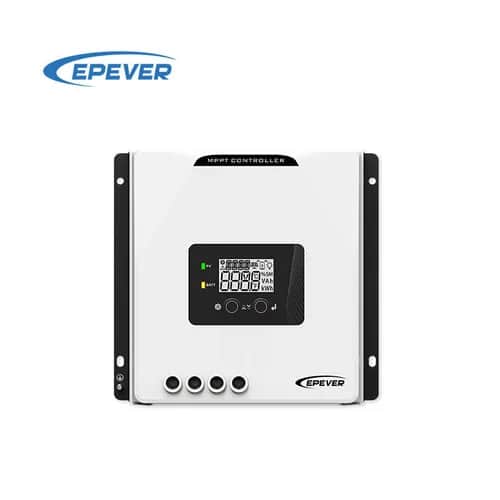
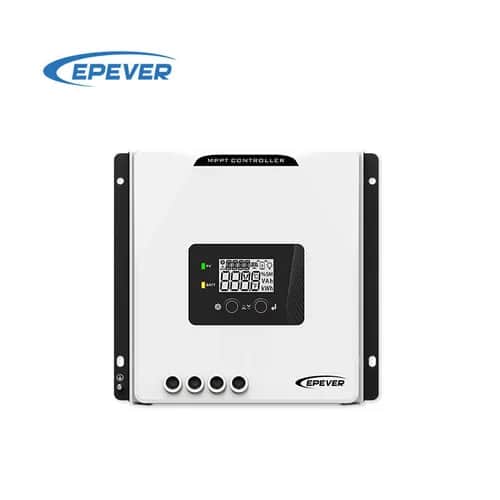
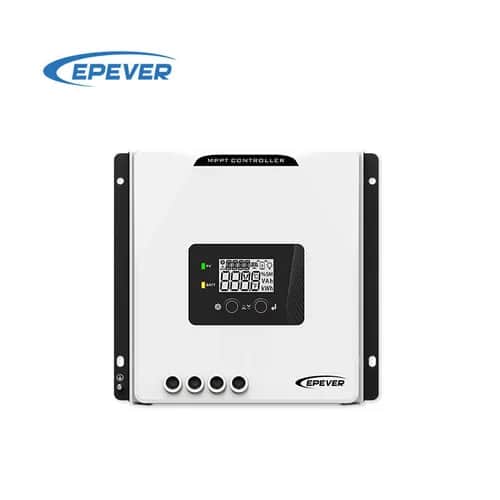
An MPPT (maximum power point tracking) controller is a DC-DC converter. It keeps the panel at its best voltage and converts the extra voltage into extra charging current. Good MPPT controllers such as the EPEVER TRC series track at ≥99.5% efficiency and convert at up to about 98%.
MPPT vs PWM at a glance
| MPPT | PWM | |
|---|---|---|
| Energy harvest | Up to ~30% more, especially in winter and with high-voltage panels | Lower; panel forced to battery voltage |
| Panel voltage | Can be much higher than battery (series panels, 60–150V input) | Should be close to battery voltage |
| Best for | 300W+ systems, 24V/48V, rooftop arrays, long cable runs | Small 12V/24V kits, street lights, tight budgets |
| Price | Higher | Lower |
| Examples at Alobari | EPEVER TRC1206 10A, TRC2206 20A, TRC4210 40A, TRC4415 40A 48V | DEMUDA 20A, DEMUDA 30A, DEMUDA 50A |
Which one is right for a home in Bangladesh?
- Single 100–150W panel, 12V battery, a few LED lights: PWM is fine, or a small MPPT like the EPEVER TRC1206 if you want more harvest.
- 300–600W of panels charging an IPS battery for load shedding: MPPT. The extra energy on cloudy monsoon days matters.
- 1kW or more, 24V or 48V battery bank: MPPT with high PV input voltage (100–150V), so you can wire panels in series and use thinner cables.
- Very tight budget or temporary setup: PWM with WiFi monitoring, such as the DEMUDA KDY-02 series.
How to size the controller current
Required current ≈ total panel watts ÷ battery voltage × 1.2. Examples:
- 300W on 12V → 300 ÷ 12 × 1.2 ≈ 30A → 30A controller
- 600W on 24V → 600 ÷ 24 × 1.2 ≈ 30A
- 1,500W on 48V → 1,500 ÷ 48 × 1.2 ≈ 38A → 40A controller
For MPPT, also keep the total open-circuit voltage (Voc) of panels in series below the controller’s maximum PV voltage, even on cold winter mornings.
Frequently asked questions
Is MPPT worth the extra cost in Bangladesh?
For systems above about 300W, usually yes — the extra harvest pays back over time, especially in winter and monsoon.
Can I use a PWM controller with a 72-cell or 36V panel on a 12V battery?
It will work but waste much of the panel’s power. Use an MPPT controller for high-voltage panels.
Do MPPT controllers work with LiFePO4 batteries?
Yes. EPEVER TRC controllers support LiFePO4 with self-activation as well as lead-acid batteries.
বাংলায় সংক্ষেপে
প্যানেলের ভোল্টেজ ব্যাটারির চেয়ে অনেক বেশি হলে বা সিস্টেম ৩০০W-এর বেশি হলে MPPT কন্ট্রোলার নিন — প্রায় ৩০% পর্যন্ত বেশি এনার্জি পাবেন। ছোট ও কম বাজেটের সিস্টেমে PWM যথেষ্ট। কন্ট্রোলারের কারেন্ট = প্যানেল ওয়াট ÷ ব্যাটারি ভোল্টেজ × ১.২।
Need help choosing?
Call or WhatsApp Alobari at +880 1611-846093 with your panel size, battery and the appliances you want to run — we will recommend the right setup. Cash on delivery and delivery to all 64 districts of Bangladesh.